How I Ran My Job Search Like an Engineering Project
Don’t Panic…
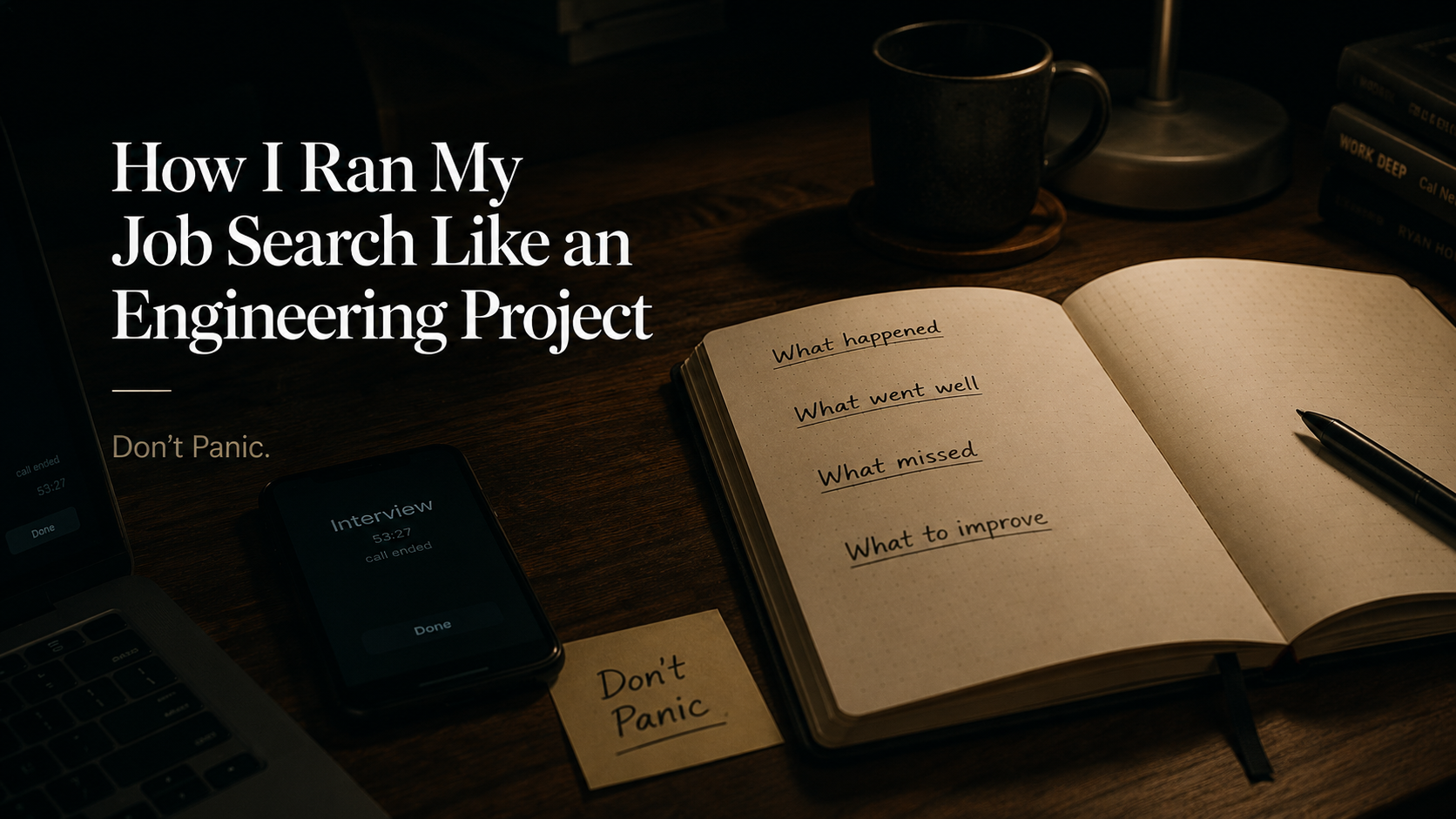
Thirty minutes into a technical interview with the CTO of a company I’d been genuinely excited about, I watched the thing collapse in real time and there was nothing I could do about it.
The brief beforehand had been strict. I had to work in Python 3.12 on Replit. I was not allowed to use TDD. I would not be allowed to use a coding environment on my own machine. The recruiter had prepped me with “the CTO is really tough and will ask the hardest of questions”. I’d prepared for that. Then the call started and he took all of it away in one sentence. I don’t care how you do it, he said. Don’t care what approach you take. No constraints. Have fun with it. And I panicked, badly.
It should have been a gift. The problem itself I could have solved by hand in five minutes. The blank cheque meant I had no idea what to aim for. By the half hour mark I knew I’d failed and ended the interview.
The system for interviewing I’d built didn’t stop that from happening. It didn’t make the interview go well, and it didn’t make the feeling of watching myself fail hurt any less in the moment. What it did was stop the failure from becoming the whole story. And afterwards, instead of lying awake running the tape back and building a case for why I was fundamentally not good enough for the room, I did what I’d done after every other interview for the previous eight months. I logged it. I got an outside read on what had actually happened, not what my own bruised ego was insisting had happened. And I moved on to the next one.
It started with something almost embarrassingly unglamorous. Before any of this, before I’d applied to a single role, I sat down and had Claude interview me about my own CV. Not edit it. Interview me. Fifty-odd questions over several days, dictated back one long answer at a time, about what I’d actually done at The Economist and at Cazoo and what it had actually achieved. I have a habit of underselling my own work, of describing what I built instead of what it was for, and the only way I found to break that habit was to be asked, repeatedly and specifically, until the honest version came out instead of the modest one. That took most of a week, and it only produced a first version. The CV got pulled apart and reworked several more times over the months that followed, as interviews kept revealing which stories landed and which ones I was still telling wrong.
Then, before I looked at a single job listing, I spent time working out what I actually wanted. Not a wishlist. A genuine position on where I thought the industry was going, what kind of company I wanted to be inside of while it went there, the difference between a company where AI is a feature bolted onto an existing product and one where it is central to what makes the product tick. I wrote that down as something close to a brief and used it to filter everything that came afterwards, before I’d invested a single hour of prep time in a process that was never going to fit.
Eight months later, after signing, I asked Claude to compare the role against that original brief. It matched almost exactly. The brief was the visible success, the part that makes a tidy story. But it wasn’t the machinery that got me through the entire interview cycle.
The part that got me through was smaller and duller than either of those. Every interview, I kept a record. Sometimes a transcript if I had one, sometimes just my own memory dumped out immediately afterwards while it was fresh. And then I’d sit with that record and ask what actually happened in there. Not how did it feel. What happened. Because I already knew, from years of doing this badly, that the two answers are often nothing alike. I have walked out of interviews certain I’d bombed and been told afterwards I was operating above my level. I have walked out feeling fine about interviews that went nowhere. My own in-the-moment read has never been a reliable narrator, and I stopped trusting it a long time ago.
What an outside, disinterested read gives you is the thing your own head cannot: an account of the interview that isn’t also trying to protect you or punish you. It’s not that Claude is a better judge of interview performance than I am. It’s that it isn’t invested. It doesn’t have skin in whether I feel like a failure tonight. That distance is the entire value.
Say that plainly and it sounds like career-hacking, like I gamed my own hiring funnel with a chatbot and now I’m here to sell you the technique. What I actually built wasn’t a trick for winning interviews. It was a way of stopping any single interview from being a referendum on my worth as an engineer. Most people go in treating each one as exactly that. Pass or fail, worthy or not, this is the interview and if it goes badly then something has been proven about you. That’s a boom and bust way to live through nine months, and it’s brutal, and I know because I used to do it that way too.
The alternative isn’t confidence. It’s process. You stop investing emotionally in any single roll of the dice and start investing in the thing that generates the rolls, the habits that keep working whether this particular interview goes well or catastrophically. That interview was catastrophic. The process didn’t care. It logged the data point, got the outside read, extracted what was useful, and moved to the next one.
The machinery was not complicated. Here it is, said plainly:
- Get an AI to interview you about what you have actually done at your job. Say everything you can think of that you actually did.
- Define a “this is what I am looking for” from a company. It keeps you looking in the right space.
- For each new job that reaches you, through LinkedIn or a recruiter or a message, run it through an AI primed with your goals. Get it to validate whether it is something you want or something you should say no to.
- After each interview, create a memcon as accurately as you can. Ask the AI what went well, what didn’t, and what can be improved.
- Before each interview, brainstorm questions to ask and work out which of your past experiences best match the company’s values.
- At offer stage, run a council of opinions about the company. Use AI to generate five different personas and perspectives to validate, steelman and poke holes in the offer.
I’ve tried to hand this to people. A few former colleagues at The Economist have gone through their own searches since, and I’ve walked them through it, more or less as I’ve walked you through it here. It makes sense to them in the moment. Then they actually get into an interview cycle, and they don’t do it. I don’t know if that’s because the habit only works if you’ve already lived through enough bad self-diagnoses to distrust your own read, or because it’s genuinely more effort than anyone wants to spend on something this emotionally loaded, or because I’m bad at explaining it, or something else entirely. I built something that held for me through the worst interview of my life. Whether it’s actually transferable to anyone else is not something I know. I only know that, for me, it turned the worst interview of my life into one data point instead of a verdict..