The Only winning move
How twelve miniatures turned into an entire wargame in a box.
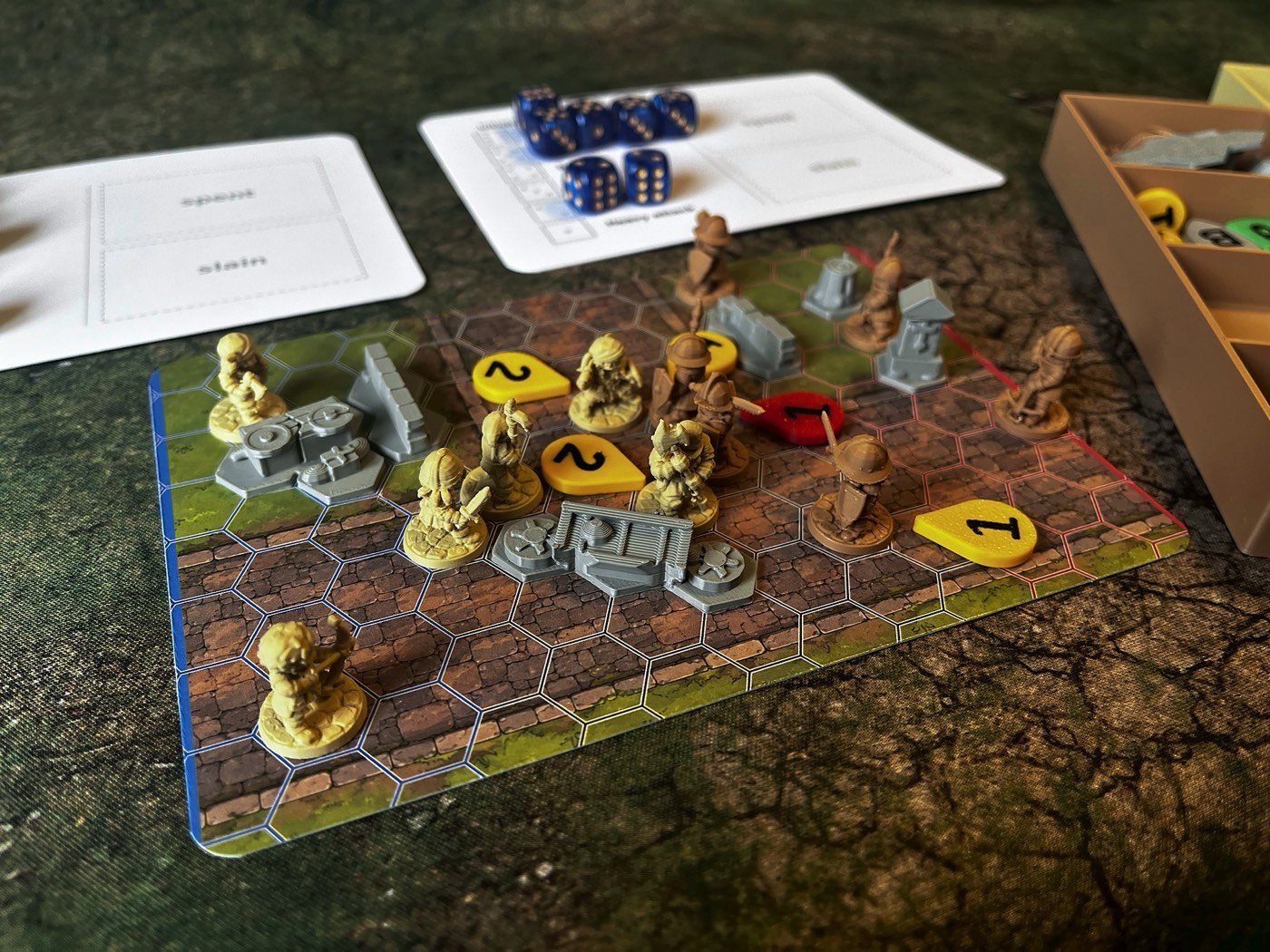
Earlier this year I came across Greathelm. It’s a micro skirmish game by Malev Da Shinobi. Six models a side, played on a sheet of A4. The quick start rules fit on a single double-sided sheet. It’s fast, it’s brutal, and it’s simple enough that you can just pick it up and muck around with it.
I wanted to play it. I really, really did.
The problem was I had nothing to play it with. I have Age of Sigmar models, but they’re big burly men, a bit too big and not quite the right theme. I didn’t have tokens. I didn’t have terrain. There were just enough small things in the way that I kept going “fine, whatever” and leaving it.
But I liked the idea a lot. So I joined the subreddit and the Facebook group and lurked. I watched people build sets and try different things and generally have more fun with the game than I was having. Then someone in the Facebook group started posting games played on hex mats, with models borrowed from Star Wars and whatever else was lying around. Something clicked in the back of my head. I mulled it over. Then I mulled it over some more.
The last big printing project I did was shrinking Bolt Action down to tiny soldiers. What if a big wargame, but small. So naturally I did the exact same thing again. What if a micro wargame, but even smaller.
It’s twelve models. How hard can twelve models be.
Last time, I went straight at it. Here’s a picture of a soldier, turn it into a model, print it, go. All in. This time I didn’t start with models. I started with concept art.
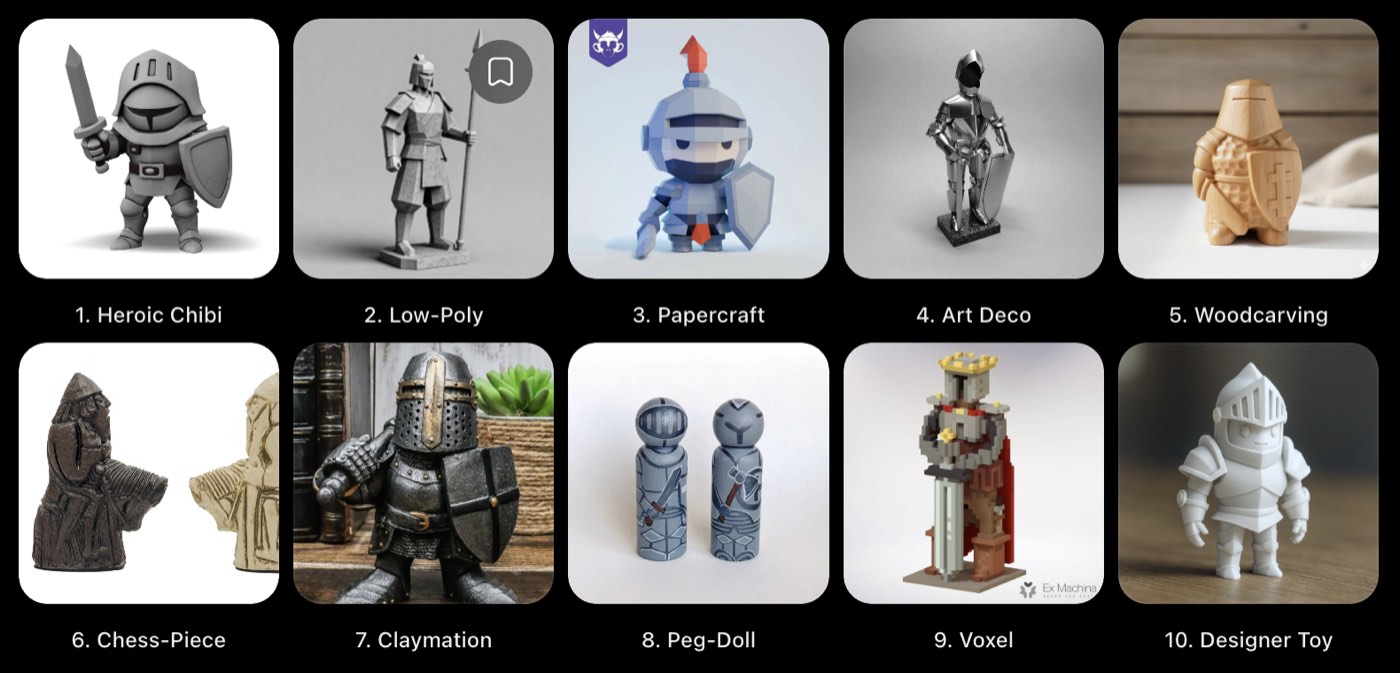
Partly that’s because I couldn’t have told you what I wanted. Nothing I found online had the vibe I had in my head, and I couldn’t pin down why. So I generated my way towards it. Comic book. Super chibi. Very blocky. Chess pieces. I took a single figure and drew him in about twenty different styles just to see what each one looked like. Then I kept iterating on the poses, the weapons and the overall feel.
Then I spent a long time going back and forth with Claude about what the two warbands should be. Teutonic Knights against someone. Heraldic knights against someone else. Lots of knights, basically, because that’s what the game is built around. After a lot of back and forth I landed on something that wasn’t knights at all. City guard against smugglers.
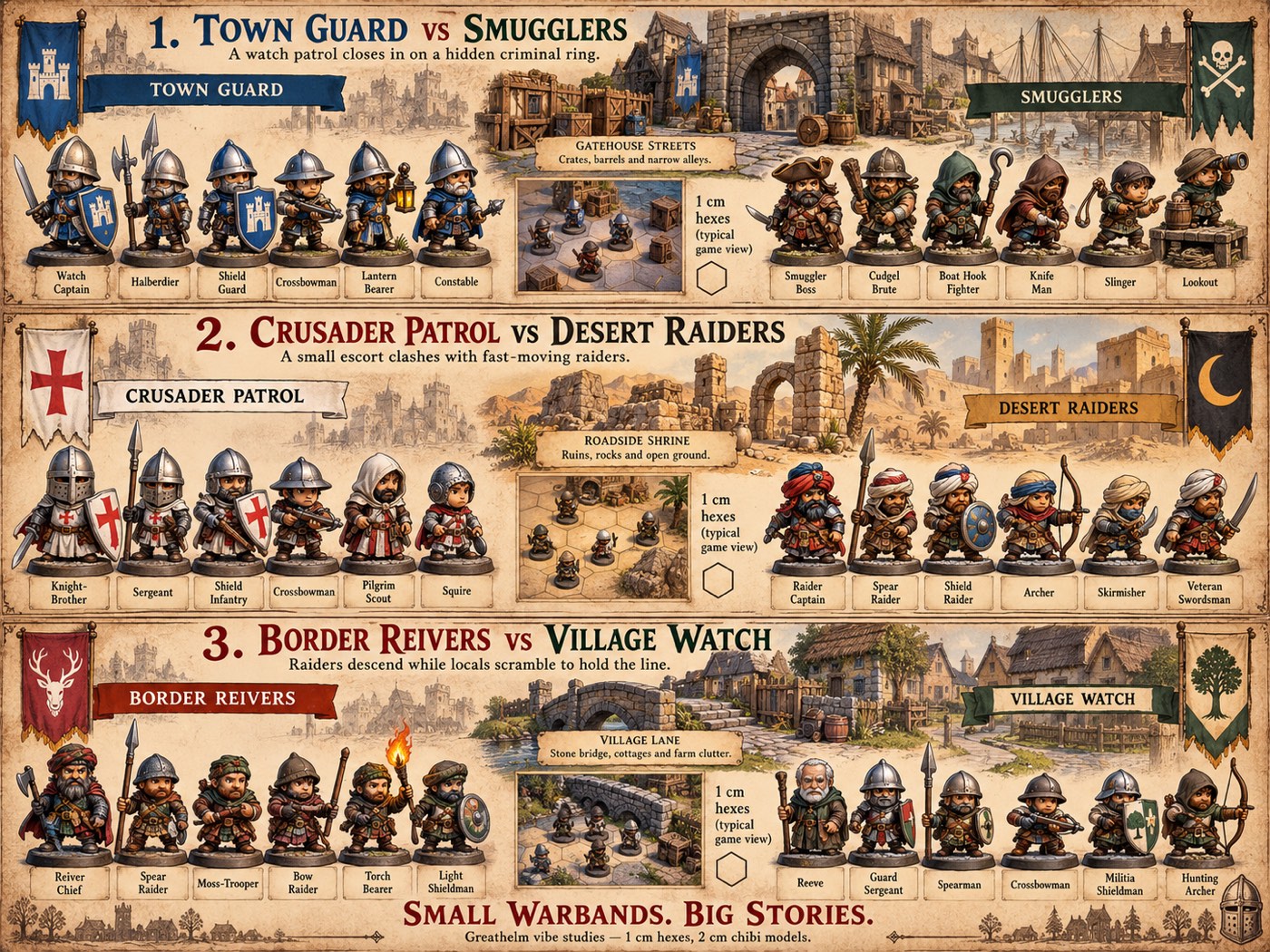
I liked it for two reasons. The two sides would look completely different from each other, which matters a lot when the models are this small. And I could build them with the advanced rules in mind. The quick start rules don’t care what anyone is carrying. Everyone is generic and runs around hitting each other. The full rulebook is dense, with weapons and armour and equipment. If every model had a specific loadout from day one, I could move up to the advanced rules without printing a new army. And I’d have two sides that played differently, without leaning into the super heavy knight thing the game is known for.
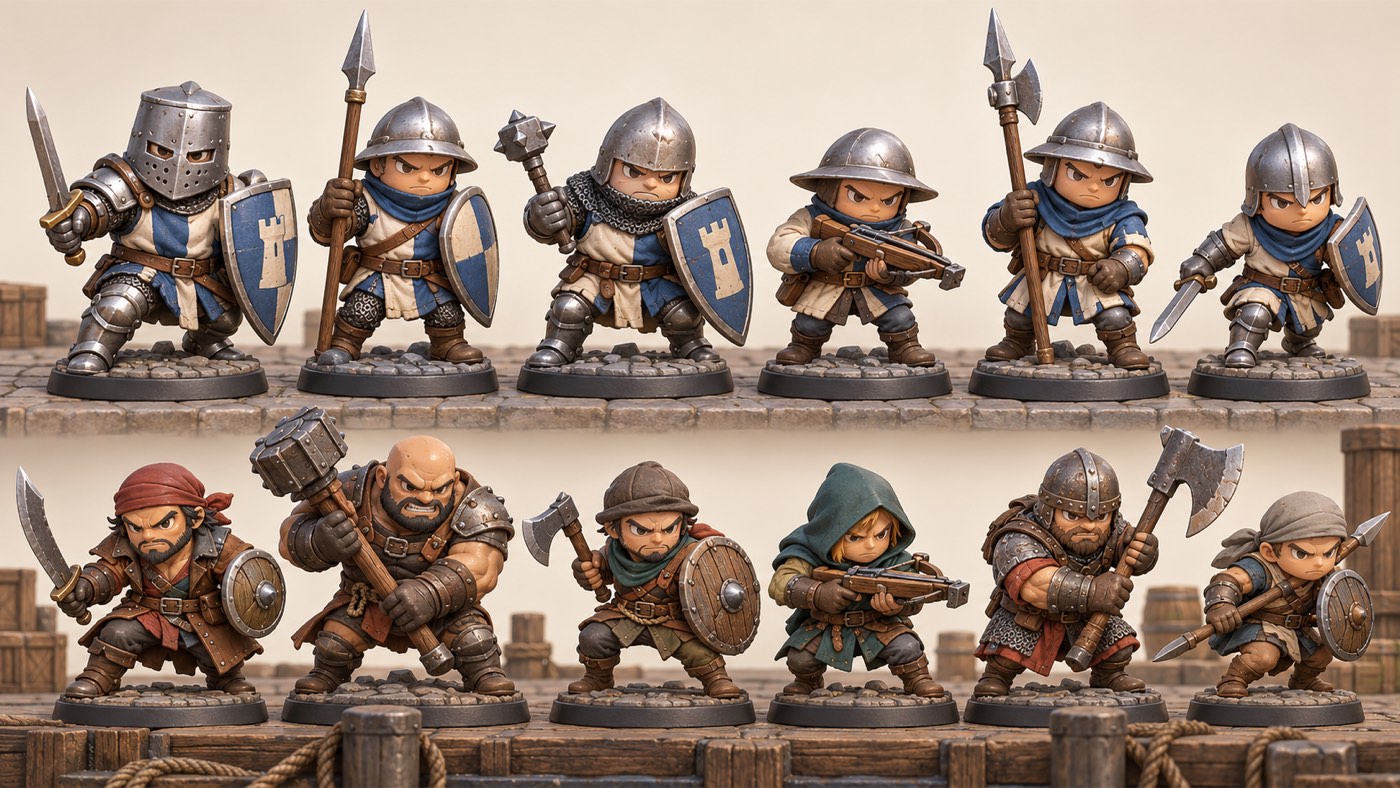
With the theme settled, I went back to one model. One guard. I generated about thirty images of him. Different poses, different looks, different styles. I printed a bunch of them to see what they looked like in my hand rather than on a screen. One was working for me, but not quite right. So I pushed it further. Away from smooth and towards blocky, with sharp edges and faces that are almost polygons.
That guy became the source image for everything else. From him, and the original warband plan, I generated the other eleven. More poses, more looks, different weapon sizes, until each one had a bit of personality. PrintBench kept all of it contained and organised, which was a godsend, because by this point there was a lot of it.
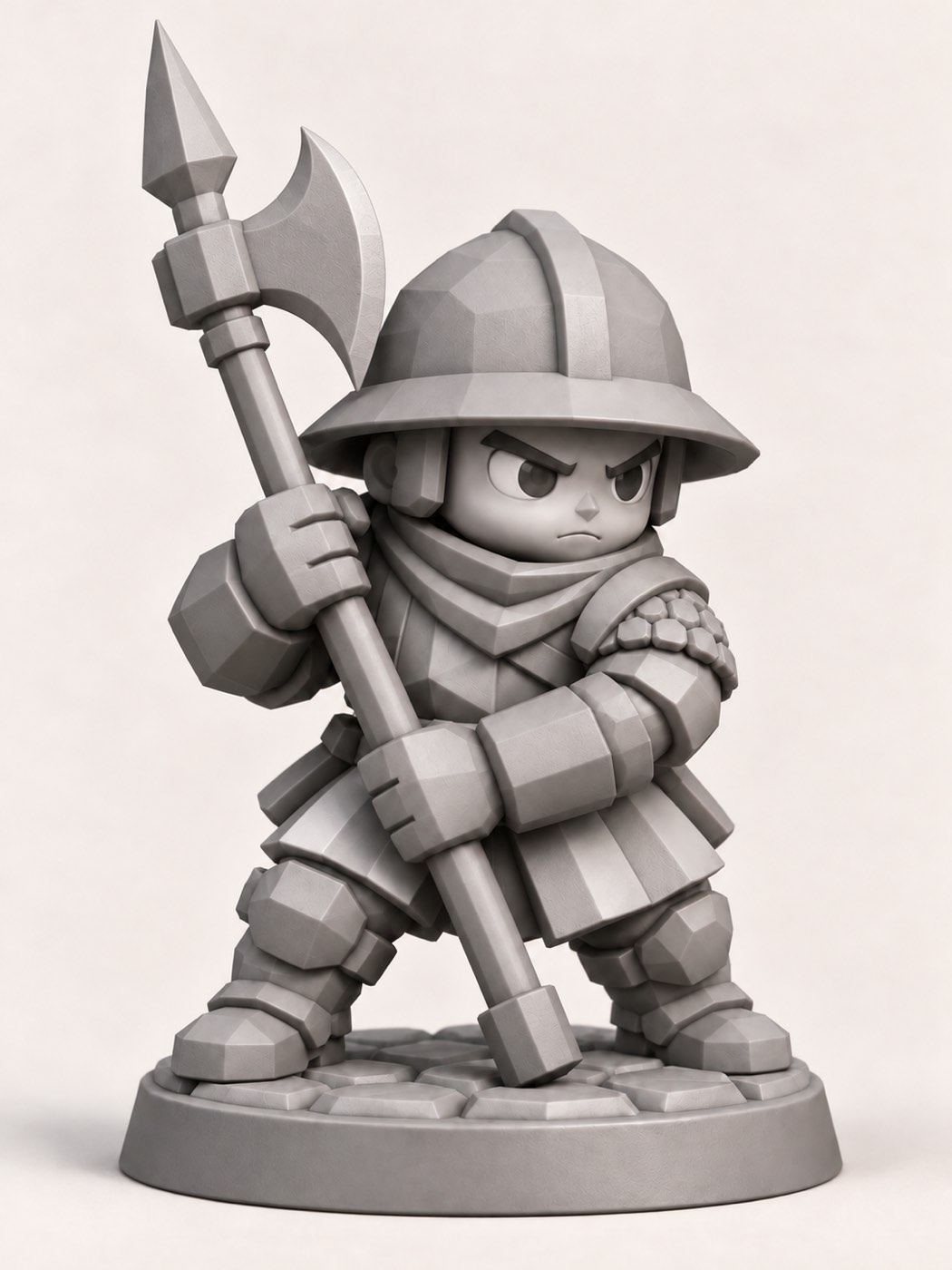
Then I started printing them properly, and the printer started having opinions.
I was still trying to make them match my shrunken Bolt Action armies. Those came with one brutal rule. Nothing taller than two centimetres. Some of the new models came out beautifully. Others looked right but sat on a base that was too big for them. In a game played in this little space, every model needs to be on exactly the same base. So the fix was to make the model bigger and keep the base the same. Which broke the rule.
I was also trying to fit the whole thing into an A6 footprint. That didn’t work either. At that scale an FDM printer just can’t make models that look nice. Too many artefacts. So I changed the base to 15mm and scaled every model up to fill it. Height stopped mattering. What mattered was how the model sat on its base. I printed thirty or forty test prints along the way.
And then, eventually, gold. Twelve models. All looking good, all correctly sized, all there.
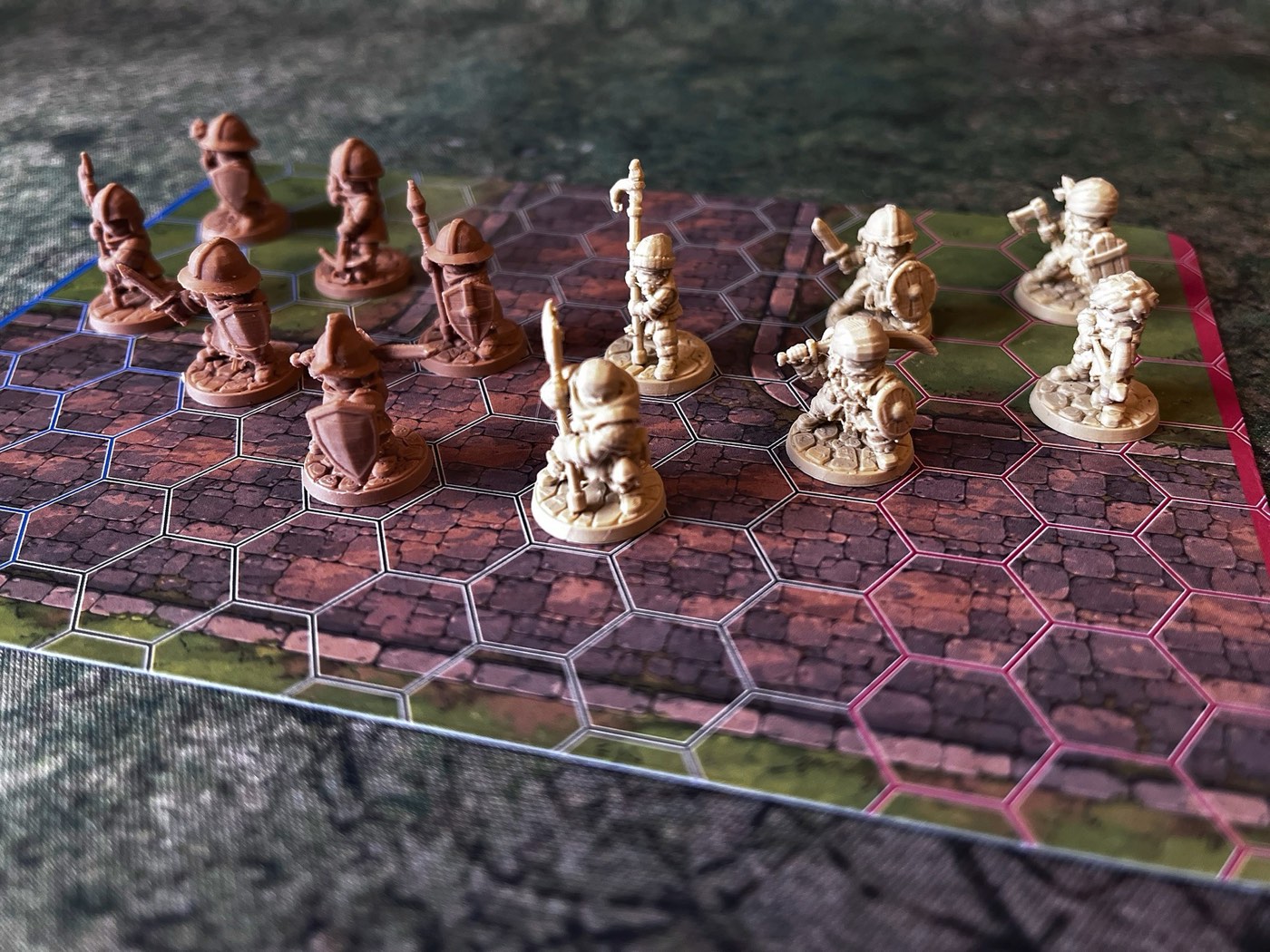
As with any AI project, the moment something works you get sidetracked. What if I made a few more warbands? That would be fun. And while I was at it, what if the poses weren’t generic? What if they were inspired by actual historical European martial arts, by the fencing masters and their manuals? Paulus Hector Mair. Joachim Meyer. Real techniques from real texts.
It turns out grounding things in real human physics does terrible things to chibi proportions. The figures started losing them, and I started fighting the model to keep them. The poses were more interesting, but they were also more complicated, and a complicated pose is hard to fit on a 15mm base. I’d reached the point where I was rabbit holing and doing too much.
So I stopped. Instead I got ChatGPT to generate a battle map, hexes and all, and printed a few at the local Ryman’s. The hexes were a little inconsistent and it was a pain to use. I put the models on it anyway and looked at it for a while. There was something there. Not finished. But something.
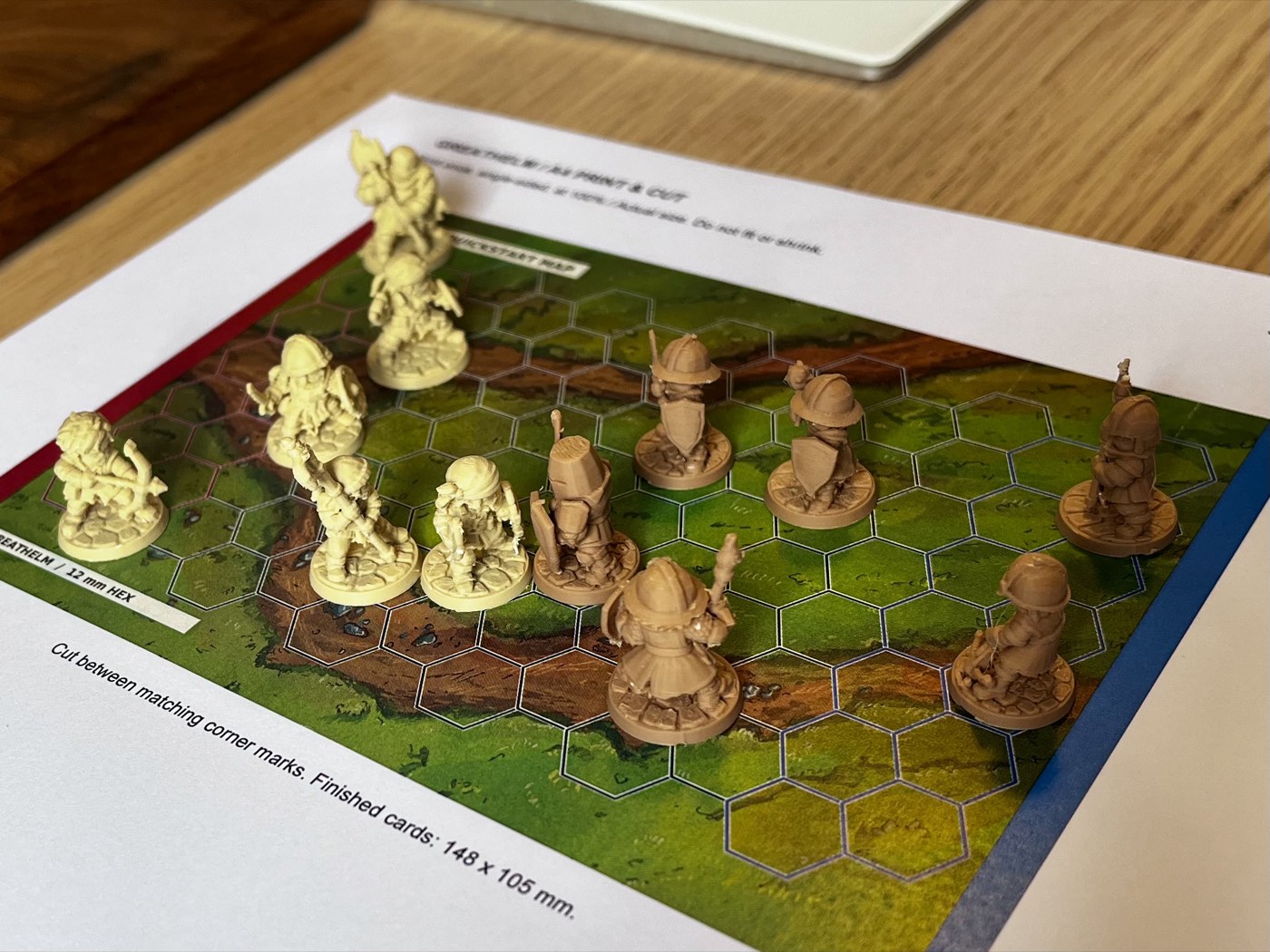
I’d been at this for about a month by now. This is naturally where the next overreach happens.
I’d started thinking about how to carry it all. Models and a sheet of paper are easy. You could chuck them in a bag and move on. I liked the idea of a cloth bag with a cloth map inside, everything rolled up, really light. But it never felt quite right. Nothing I came up with quite landed.
Then I realised it could be a box.
And if it was a box, I wanted to print it on my A1 Mini. The A1 Mini has a print bed of 180 by 180 millimetres. That’s not a preference. You can’t negotiate with it. So I worked backwards. 15mm hexes, thirteen by eight, comes out at roughly 170 by 120 millimetres. The same ratio as an A4 page. A little smaller than A5. With just enough room left over for the walls of a box.
Once I had that number, everything else fell into place very quickly. I got Claude Code to generate a parametric box. Two inserts, one for each player, with room for their models, their dice and their tokens, plus some scatter terrain each. Space for the battle maps, the player aids and a rulebook. A lid with a hex grid on top, so it doubles as a board. Lift the inserts out and the box is a dice tray. I spent a lot of time thinking about how much space everything would actually take, printed test inserts to see what I was dealing with, adjusted, and printed more.
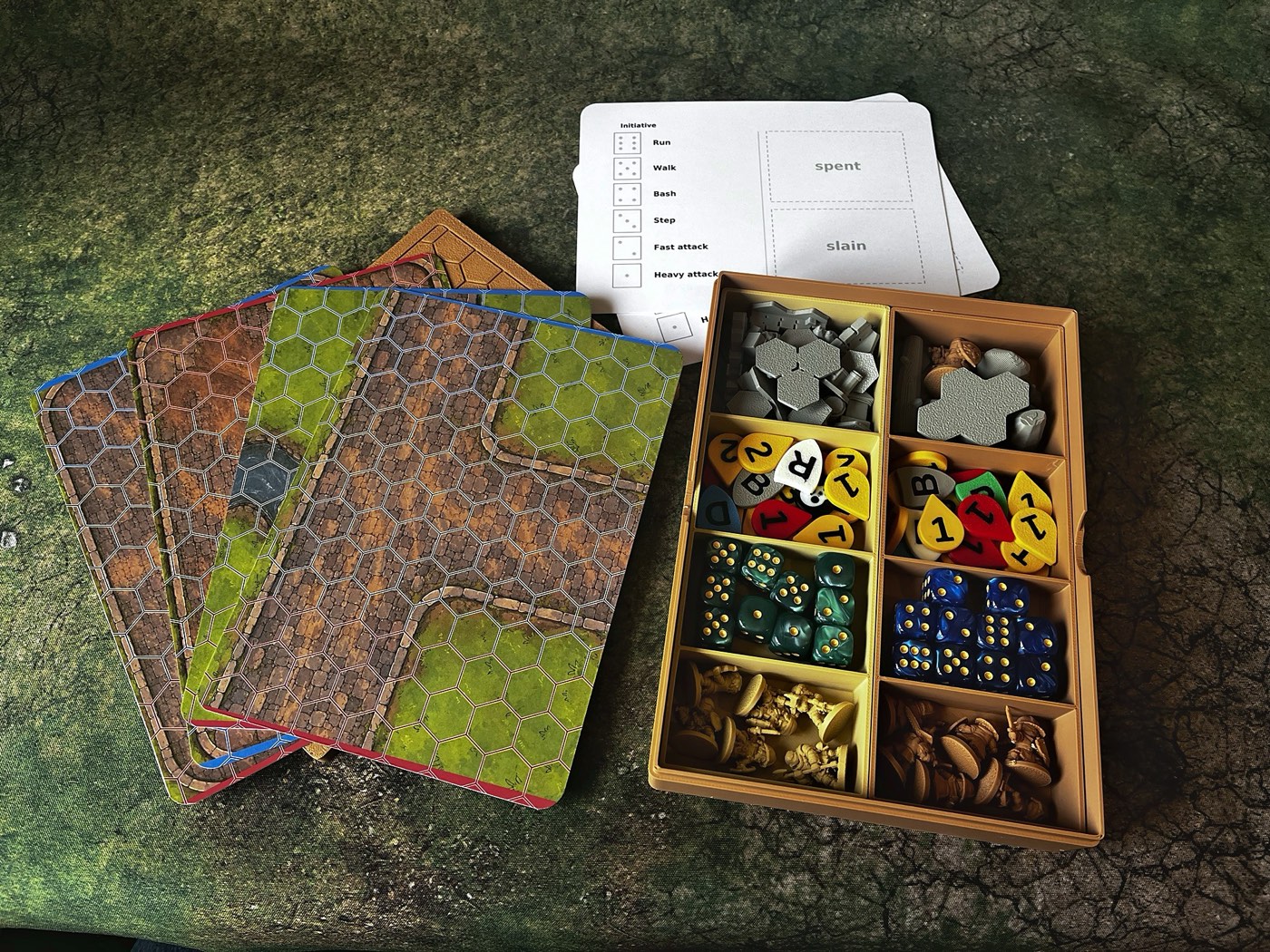
The maps needed redoing too. The Ryman’s ones had ChatGPT’s hexes baked into the art, and they were a little off. I could have asked an agent to fix each new map, but it would have reinvented the wheel every time and I’d never know if two maps matched. So Claude Code wrote a small tool. Art and a config file go in. The same 15mm grid comes out, every time. It has a test that checks every hex corner against Malev’s quick start sheet to within a hundredth of a millimetre. Which is perhaps a bit much for something printed on card.
The rulebook got the same treatment. I took the quick start rules, reformatted them to A6, and had a copy properly printed for myself. It looks like a real rulebook you’d buy in a shop. It’s gorgeous.
Then I needed scatter terrain. Obviously.
I opened ChatGPT and gave it the spec. The hexes are 15mm. I need terrain of the following types. Let’s spike out what that might look like. Then, on a lark, I asked it to just generate the STLs.
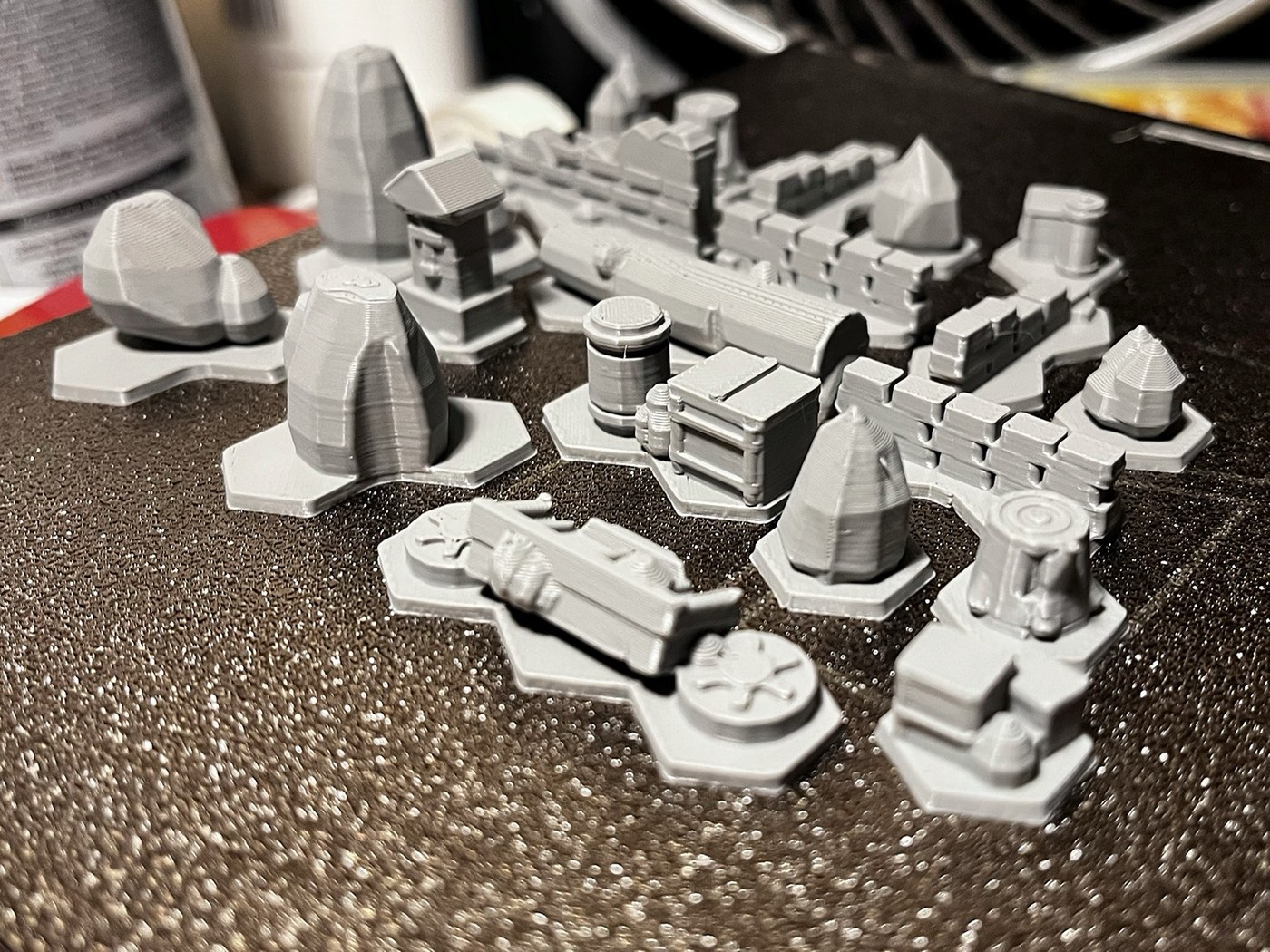
It bloody well did. In a single conversation. Blazingly fast.
The figures went through the whole pipeline. Concept art, PrintBench, Meshy, slicing, test print after test print, all to get them looking right. The terrain came out of a chat window. It helped that I’d decided good enough was good enough, rather than chasing some arbitrary level of quality. It also helped that by then I could say exactly what I wanted. 15mm hexes. Has to fit in this insert. A month earlier I couldn’t have written that sentence.
So here’s where it ended up. Sixteen plates on the printer, plus three files for a proper print shop, for the battle mats, the player aids and the rulebook. Print all of that and you have a whole wargame in a box smaller than A5 that you can take anywhere.
Looking back, the timeline is lopsided. I spent about a month on the models. Variants, poses, styles, test prints, sidetracks. Then I decided it was a box. From that decision to finished, box and inserts and tokens and terrain and rulebook, took about two weeks.
The box is the bit I’d have called overreach. It’s the moment twelve models turned into a product. It’s also the moment the project stopped drifting. Every AI tool I used was happy to give me one more variant, one more pose, one more style, for as long as I kept asking. None of them told me where the edges were. The printer bed did that. It had been 180 by 180 the whole time. I just hadn’t treated it as a limit until I knew what I was building.
I’m not sure the month was wasted either. I spent it working to the wrong constraints. First a height limit I’d carried over from the last project. Then a footprint the printer couldn’t manage. Each one broke as soon as real plastic came off the bed, and each one taught me something I needed for the right one. Could I have started from the printer? I’d like to think so. I suspect not.
I posted it to the Greathelm subreddit and put everything printable up on MakerWorld. I left the reformatted rulebook out on purpose. The rules are Malev’s. Somebody else’s hex mat photos started all this. Now mine are out there for someone else to scroll past.
All of this because I wanted to play a game and didn’t have any models. That’s a little ridiculous.
I still haven’t actually played the game…
Links
- Greathelm: the micro skirmish game by Malev Da Shinobi
- Greathelm Travel Set on MakerWorld: the printable models, box, inserts and terrain
- greathelm: the battle map hex grid tool
- PrintBench: the pipeline for concept art to printable models
- An army of one prompt: the previous project, shrinking Bolt Action